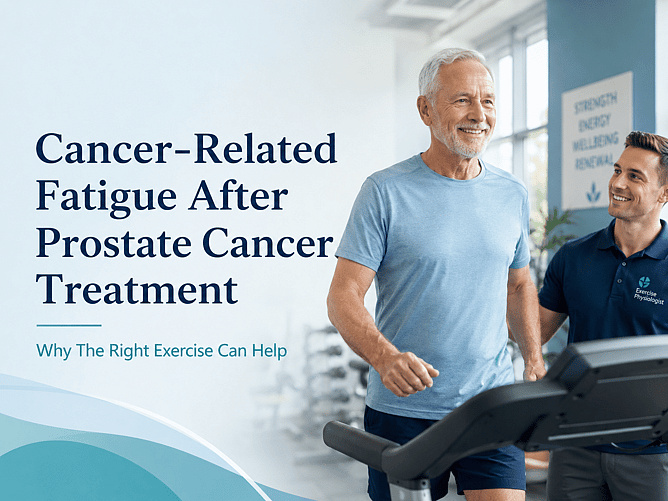
Cancer-Related Fatigue After Prostate Cancer Treatment: Why The Right Exercise Can Help
Cancer-related fatigue is one of the most common and most underestimated side effects of prostate cancer treatment. It is not ordinary tiredness. It does not lift after a good sleep or a quiet weekend. Many men describe it as a heavy, drained, slowed-down feeling that affects strength, mood, motivation and the ability to enjoy normal life.
The most effective response is often the opposite of what men expect. Rather than rest alone, the right kind of structured exercise has been shown to reduce cancer-related fatigue, rebuild physical capacity and restore confidence. At PROST!, this is delivered through supervised group sessions led by exercise physiologists who understand the realities of prostate cancer recovery.
What is cancer-related fatigue?
Cancer-related fatigue is a persistent, whole-body exhaustion linked to cancer or its treatment that does not fully resolve with rest. It is recognised as a distinct clinical condition, not simply a symptom of being unfit or run down.
Common signs include:
Low physical energy and a sense of heavy limbs
Reduced motivation to move or exercise
Poor concentration or mental fog
Lower tolerance for normal daily tasks
Sleep that no longer feels restorative
Emotional flatness alongside physical tiredness
The pattern is often unpredictable. Some days feel manageable, others do not. Energy may be reasonable in the morning and disappear by mid-afternoon. That unpredictability erodes confidence and often leads men to do less, which makes the underlying problem worse.
Why fatigue is so common after prostate cancer treatment
Fatigue after prostate cancer treatment is rarely caused by one thing. It usually reflects a combination of physical, hormonal and emotional factors.
The main contributors are:
Physical recovery from surgery
The cumulative effect of radiation therapy
Hormonal changes from androgen deprivation therapy
Loss of muscle mass and cardiovascular fitness
Disrupted sleep
Anxiety, low mood or emotional stress
Reduced physical activity over time
Pain, medication side effects or other health issues
When several of these are present at once, fatigue can become the defining feature of the recovery period.
How surgery contributes to ongoing tiredness
Surgery places a major demand on the body, and recovery diverts energy into tissue repair and inflammation control. Activity also drops sharply during the post-operative period. Even a few weeks of less walking, less lifting and less daily movement is enough to reduce fitness significantly. Once that happens, ordinary tasks require more effort, and fatigue feels worse for doing less.
How radiation therapy contributes
Radiation-related fatigue tends to build gradually over the course of treatment and can persist for weeks afterwards. Inflammation, disrupted routines, poorer sleep and reduced activity during treatment all play a role. Many men quietly cut back on movement during this period, which accelerates deconditioning and prolongs the fatigue.
How hormone therapy contributes
Androgen deprivation therapy lowers testosterone, which directly affects muscle mass, stamina, drive and recovery. Men on hormone therapy often notice reduced strength, increased body fat, mood changes and a flatter overall sense of energy. This is why fatigue from hormone therapy can feel different from ordinary tiredness. It has a hormonal driver that exercise is well placed to address, particularly through resistance training that protects muscle and bone.
Why rest alone does not solve cancer-related fatigue
Rest is important during recovery, but rest alone rarely resolves cancer-related fatigue and often makes it worse over time. Prolonged inactivity reduces cardiovascular fitness, weakens muscles, stiffens joints and disrupts sleep, all of which intensify the underlying fatigue.
This creates a predictable cycle. Men feel tired, so they rest. Their fitness drops, so daily life becomes harder. They feel more tired, so they rest more. Breaking the cycle requires structured movement, not more inactivity.
Why exercise reduces cancer-related fatigue
Appropriately prescribed exercise is one of the most evidence-based treatments for cancer-related fatigue. The benefit is not about pushing harder. It is about rebuilding the physical capacity that fatigue and inactivity erode.
Exercise helps by:
Improving cardiovascular fitness so daily tasks demand less effort
Rebuilding muscle mass and strength lost during treatment
Supporting bone density, which matters during hormone therapy
Improving sleep quality
Reducing stiffness and physical discomfort
Lifting mood and mental clarity
Restoring confidence in movement and daily independence
The effect is cumulative. Men often notice practical improvements (walking feels easier, stairs are less daunting, recovery from activity is faster) before they describe themselves as feeling more energetic.
What the right exercise looks like after prostate cancer treatment
The right exercise after prostate cancer treatment is structured, gradual, and tailored to the individual. It is not high intensity. It is not random. It combines aerobic work, resistance training, mobility and balance, and it adjusts to energy levels and treatment side effects.
Aerobic exercise
Gentle to moderate aerobic activity improves the efficiency of the heart, lungs and circulation, which directly reduces the sense of heaviness that comes with fatigue. Walking is usually the best starting point because it is familiar, low-risk and easy to scale. Light cycling or stationary bike work can also be appropriate. Sessions are progressed gradually rather than pushed.
Resistance training
Resistance training is the single most important component for men dealing with hormone therapy side effects, muscle loss or persistent fatigue. Stronger muscles reduce the effort cost of ordinary life. A typical program includes sit to stand exercises, step ups, resistance band rows, light dumbbell or machine work, and hip and leg strengthening. Done consistently, this rebuilds muscle, supports bone health, improves balance and reduces day-to-day tiredness.
Mobility and flexibility
Stiffness adds an energy cost to every movement. Mobility work reduces that cost by improving how the body feels to move. It supports walking mechanics, posture and recovery between sessions, and it makes men more willing to stay active.
Balance and functional training
Balance and functional exercises bridge the gap between the gym floor and real life. Controlled stepping, sit to stand drills, turning and reaching, and light lifting tasks all support daily independence. They also rebuild the confidence that fatigue often takes away.
Why supervised exercise matters more than guesswork
The biggest practical question for men managing fatigue is how much exercise is enough and how much is too much. Doing too little produces no benefit. Doing too much causes a crash and discourages further activity. Supervised exercise resolves this by removing the guesswork.
Exercise physiologists are university-trained allied health professionals qualified to prescribe exercise for people with chronic and complex conditions, including men recovering from cancer treatment. At PROST!, sessions are led by exercise physiologists who can:
Tailor exercise to treatment history and current capacity
Adjust intensity when energy is low
Progress sessions safely as fitness improves
Monitor technique and recovery
Account for side effects such as muscle loss, stiffness or balance issues
Provide structure and consistency that is hard to maintain alone
This level of support matters because fatigue after treatment is not the same as ordinary deconditioning. It needs an informed, measured approach rather than generic gym programming.
The benefits of group exercise for men with cancer-related fatigue
Cancer-related fatigue is often isolating. Men withdraw socially, skip activities and feel that others do not understand what they are going through. Group exercise addresses both the physical and the social side of recovery at the same time.
A supervised group setting provides:
Accountability that keeps men showing up on lower energy days
Encouragement and shared experience
Normalisation of treatment side effects
Camaraderie and conversation with men who understand
Stronger motivation than exercising alone
This combination of structured exercise and peer support is what PROST! is built around, and what you will find at our support groups across Perth.
What a typical PROST! session includes
A session for men managing cancer-related fatigue is practical, achievable and progressive. It is not extreme, and it does not need to be.
A typical session covers:
Warm up: light walking, mobility drills or gentle cycling to prepare the body
Strength work: functional exercises for the legs, hips, back and upper body, scaled to the individual
Aerobic component: short bouts of walking or light cardiovascular work to build endurance
Balance and mobility: exercises to improve steadiness and ease of movement
Cool down: gentle stretching and a gradual reduction in intensity
Each component is adjusted by the supervising exercise physiologist. Some men do more, others need a gentler progression. The goal is sustainable progress, not maximum effort.
How to pace yourself without avoiding activity
Pacing is the practice of using energy wisely so the body builds capacity without repeated boom-and-bust cycles. It is not the same as avoiding activity.
Effective pacing involves:
Breaking larger tasks into smaller parts
Alternating activity with brief recovery
Resisting the urge to do too much on a good day
Keeping some regular movement on lower energy days
Distinguishing manageable tiredness from genuine exhaustion
Working with an exercise physiologist makes this much easier to apply in practice.
How long does cancer-related fatigue last?
Cancer-related fatigue varies between individuals. For some men, it improves within weeks of finishing treatment. For others, particularly those on ongoing hormone therapy, it can persist for months or longer. Recovery is rarely linear. Sleep, stress, treatment cycles, pain and other health issues all affect how a given week feels.
The value of a structured exercise program is consistency through those ups and downs. Rather than stopping when energy dips, men keep moving in a way that matches what they can manage. That continuity is usually what produces meaningful improvement over time.
Signs the program is working
Practical improvements often appear before men describe themselves as feeling more energetic. Common early signs include:
Walking feels easier
Stairs are less daunting
Recovery after activity is faster
Sleep is more restorative
Mood is steadier
Daily tasks can be completed without crashing afterwards
These are the markers worth watching. They indicate that capacity is rebuilding, which is what reduces fatigue over the longer term.
Cancer-related fatigue after prostate cancer treatment is real, common and often multifactorial. It deserves a structured response rather than guesswork or extended rest. Walking, resistance training, mobility, balance work and supervised group exercise all contribute to a measurable reduction in fatigue and a return to everyday confidence. PROST! provides exactly this kind of supervised, group-based exercise designed for men at this stage of recovery, with sessions led by exercise physiologists who understand the realities of prostate cancer treatment.
You can read more about the PROST! Exercise 4 Prostate Cancer program, including session times, locations and costs, before you visit.