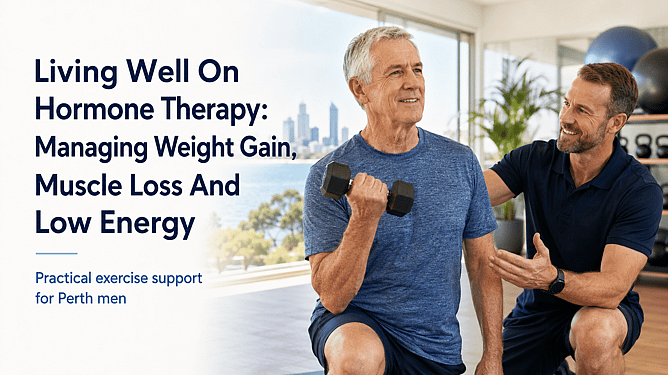
Living Well On Hormone Therapy: Managing Weight Gain, Muscle Loss And Low Energy
For many men with prostate cancer, hormone therapy is a central part of treatment. It can be highly effective, but it rarely arrives without side effects, and those side effects have a habit of showing up in ordinary daily life. Weight creeps on. Muscle softens. Energy drops away. Mood shifts. And somewhere in all of that, a man can start to feel less like himself. For some the change is gradual. For others it seems to land all at once.
That is a hard thing to sit with, particularly for men who have spent their lives being active, capable and self-reliant. Clothes fit differently. Jobs that used to be easy take more out of you. Motivation dips. The body feels heavier and slower to respond. It is not only physical. It touches confidence, routine and how a man feels about himself.
The encouraging part is that none of this is something to simply put up with. Hormone therapy changes the body, but the right kind of exercise can change how a man lives with it - managing weight, holding on to muscle, lifting energy and restoring a real sense of control over everyday life. At PROST!, that is exactly what structured group sessions led by exercise physiologists are built to do.
What Hormone Therapy Actually Does
Hormone therapy for prostate cancer is usually called androgen deprivation therapy, or ADT. It works by lowering testosterone or blocking it from reaching prostate cancer cells. Because many prostate cancers rely on testosterone to grow, reducing it can slow the disease and improve treatment outcomes.
It is used in a range of situations - alongside radiation therapy, or for more advanced or recurrent cancer - and the duration varies from man to man. The effect on the body, though, tends to follow a familiar pattern. Lower testosterone shifts the body's internal settings in ways that influence muscle, fat, energy, mood and bone health. That is why so many men find the real challenge is not only the treatment itself, but learning to live well alongside what comes with it.
Why The Body Starts To Feel Different
Testosterone does a lot of quiet work in the male body. It underpins muscle and strength, fuels energy and drive, protects bone, and plays a part in emotional wellbeing. When it drops, all of those systems feel it.
Men on hormone therapy often gain weight, especially around the middle, while losing lean muscle and the strength that goes with it. Fatigue sets in, exercise feels harder than it used to, sleep and mood can become unsettled, and motivation flattens out. Many describe still recognising themselves in the mirror while no longer quite feeling like themselves inside their own body. Movement is less automatic. Recovery takes longer. Food, exercise and stress all seem to land differently than they once did.
Knowing that these are recognised, well-documented effects of treatment can be a relief in itself. They are common, they are real, and they are not a sign of weakness or of doing something wrong.
Why Weight Gain Is So Common
Weight gain is one of the changes men notice first, and it usually has several causes stacking up at once rather than a single one.
Lower testosterone shifts body composition, so a man can lose muscle and gain fat even before the scales move much. Fatigue then quietly reduces how much he moves through the day, which drops his overall energy use. And because lost muscle lowers the body's resting metabolic demand, the maths tips further toward storing fat. Add in the way disrupted routine and low mood affect appetite and food choices, and the picture becomes clear: this is rarely a simple case of eating too much.
That is why "just eat less" is such poor advice here. The better response addresses the whole picture, and especially protects the lean muscle that keeps a man's metabolism and daily function ticking over.
Muscle Loss Matters More Than It Looks
Muscle loss is one of the most significant effects of hormone therapy, and one of the easiest to miss. A man often feels softer, weaker or less steady on his feet well before he realises how much muscle has actually slipped away.
It matters because muscle is what daily life runs on. Standing up from a chair, climbing stairs, carrying the shopping, holding good posture, walking without effort, keeping your balance, protecting your joints and bones - all of it draws on muscle. When that reserve drops, every one of those tasks costs more effort, and that effort feeds straight back into fatigue.
This is how the deconditioning cycle takes hold. A man feels tired, so he moves less. Moving less makes him weaker. Being weaker makes life feel harder, which makes him more tired again. Breaking that loop is one of the most important things exercise can do during hormone therapy, and it is far easier to do early than to claw back later.
Low Energy Is Not Just In Your Head
The fatigue that comes with hormone therapy is not a matter of attitude or willpower. It is a genuine biological response to treatment, driven by lower testosterone, reduced muscle, declining fitness, broken sleep and the considerable emotional weight of cancer treatment all pulling in the same direction.
Men describe it in consistent terms - feeling flat, drained, foggy, slow to recover from ordinary activity, and short on the spark they used to take for granted. It seeps into work, relationships, hobbies and confidence. Cruelly, it also makes exercise feel least appealing at the very moment exercise stands to help most. That contradiction is one of the strongest arguments for structured support, because men are far more likely to keep moving when the exercise is guided, realistic and built around how they actually feel on the day.
What The Right Exercise Can Do
Exercise is one of the most effective tools available for managing the side effects of hormone therapy, but the word "right" is doing a lot of work in that sentence. Too much too soon is discouraging. Too little achieves little. The approach that works is progressive, tailored and built to be sustained.
Done well, exercise helps a man manage his weight, hold on to or rebuild muscle, get stronger, push back against fatigue, improve his metabolic and bone health, and lift his mood and confidence. None of that is abstract. It shows up in the practical business of living - walking, stairs, lifting and general movement all start to feel easier, which makes the whole day less tiring and a good deal more manageable. The point of the gym, in other words, is everything that happens outside it.
Resistance Training Comes First
If ADT strips muscle and strength, then resistance training is the most direct answer to it, which is why it sits at the centre of a good program. This does not mean heavy lifting or anything resembling bodybuilding. It means strength work prescribed sensibly, enough to challenge the muscles safely, with steady progression over time.
In practice that might look like sit to stand work, step ups, resistance bands, machine-based exercises, dumbbell or cable movements, dedicated hip and leg strengthening, upper body pushing and pulling, and core stability. The aim of all of it is the same: maintain or rebuild lean muscle, restore strength, and take the effort out of everyday tasks so a man feels capable again rather than drained by normal life.
At PROST!, exercise physiologists shape this work around the individual, factoring in treatment stage, current fitness, pain, fatigue and confidence. That tailoring matters most for men coming back to exercise after a stretch of inactivity, when the gap between what the body used to do and what it can do today needs handling with care.
Aerobic Exercise Still Earns Its Place
Strength work leads, but it does not work alone. Aerobic exercise - walking, cycling or other steady, moderate-intensity movement - supports energy, heart and lung fitness, circulation, fat management and mental clarity, and it takes the edge off fatigue rather than adding to it.
For most men, walking is the natural place to start. It is familiar, it costs nothing, and it scales easily from a few short walks up to longer or brisker efforts as fitness returns. The most effective programs pair this aerobic work with resistance training rather than leaning on either one alone.
Bone Health Belongs In The Plan
Hormone therapy can also reduce bone density, which gives exercise a role beyond weight and muscle. Weight-bearing activity and strength training both help support bone, particularly when they are kept up consistently over months rather than chased in bursts.
This is not a minor footnote. Lower bone density raises fracture risk, and that risk climbs further when it combines with lost muscle and shakier balance. Exercise that builds strength, posture and stability helps keep a man safer and more independent, which is why PROST! sessions are designed with mobility and balance in mind alongside muscle and energy.
Balance, Mobility And Getting Through The Day
Men on hormone therapy are not chasing better numbers on a chart. They want to feel steady, move freely and keep doing ordinary life without second-guessing their body. Good programming reflects that by giving real attention to balance, mobility, flexibility and functional movement.
The payoff is practical and immediate: getting in and out of the car, walking on uneven ground, turning and reaching without hesitation, managing stairs, bending to pick something up, getting out of bed more comfortably. Even modest gains in these areas make daily life noticeably easier, and when movement feels easier, men keep doing it, which reinforces every other benefit over time.
Why Supervision Changes The Outcome
A lot of men on hormone therapy know they should be exercising. What they are missing is the answer to what, how hard and how to keep it up when energy is scarce. Some become so cautious they do too little, wary of overdoing it. Others try to pick up where they left off years ago and are knocked flat when the body no longer responds the same way. Both roads lead to frustration, and frustration leads to stopping.
This is where supervised exercise earns its keep. At PROST!, sessions are led by exercise physiologists who understand precisely how prostate cancer treatment affects the body and how to prescribe around it. They match the work to each man's capacity, symptoms and stage of treatment, dial it up or down depending on how the day is going, aim it at the issues that matter most, and keep the group moving safely and with purpose. That blend of professional oversight and steady progression is exactly what is needed when treatment has worn down energy, strength and motivation.
The Strength Of Doing It Together
There is a social dimension to all of this that is easy to underestimate. Changes in weight, energy and body confidence can leave men feeling isolated. They pull back from activities they once enjoyed, or quietly assume that others cannot really understand what they are dealing with.
The group setting at PROST! works directly against that. Men are not exercising alone with a printed list of instructions, they are part of a structured, supportive room full of others who know the realities of prostate cancer treatment first-hand. That brings accountability, a reason to turn up, encouragement on the low days, shared understanding and a genuine sense of community. It also makes a real difference to whether men stick with it, because it is far easier to keep going when the sessions are led by professionals and shared with men walking the same path.
Many members say the biggest gain is not physical at all. The prostate cancer support in Perth they find in that room carries them through the hardest weeks of treatment.
What A Session Can Look Like
A supervised session does not need to be intimidating to be effective. It tends to work best when it is practical, progressive and clearly tied to real-life function.
It usually opens with a gentle warm up of easy walking, cycling or mobility work to get the blood moving and the body ready. From there it moves into the strength work that anchors the session, training the legs, hips, back, chest and shoulders with body weight, bands, machines or free weights, scaled to the individual. A block of aerobic work, often walking intervals or similar moderate effort, builds stamina and cardiovascular fitness. Balance and mobility drills sharpen steadiness and movement quality. And it closes with a cool down of light stretching and recovery, so a man finishes worked but not wiped out. Because exercise physiologists are running the room, every part of this can be adjusted to how a man is coping that day, which matters enormously when fatigue, pain and motivation rarely sit still.
Small Wins Add Up
One of the most encouraging things about exercise during hormone therapy is that the benefits tend to surface in small, practical ways long before anyone would describe themselves as transformed. Clothes fit a little better. Walking feels easier. Stairs stop being an event. A man stands a bit taller, carries the groceries without the same strain, wakes up less stiff, and finds his energy holding steadier across the day. He feels better leaving a session than he did walking in.
These are not trivial. They are the visible signs that progress is happening, even when it is gradual, and over time they compound into better body composition, more confidence and a stronger sense of being in control.
Progress Takes Time, And That Is Normal
It is worth being honest: hormone therapy places a sustained demand on the body, and exercise is not a switch that flips the side effects off overnight. Progress is gradual, and some weeks will simply feel better than others. That is to be expected, not a sign that anything is going wrong.
The goal is not perfection. It is consistency and momentum. A structured routine helps a man hold on to more of his strength, mobility and confidence than he otherwise would, and it replaces the feeling of passively enduring treatment with the experience of actively doing something about it. At PROST!, qualified exercise physiologists are there to help him adapt, progress and stay engaged through all of it.
Living Well Through Treatment
Living well on hormone therapy is not about pretending the side effects are not there. It is about meeting them in a practical, informed way. Weight gain, muscle loss and low energy are common, but they are not reasons to give up on physical wellbeing, and the right exercise can help a man hold his strength, manage his weight, ease his fatigue and stay connected to the life he wants to keep living. Just as importantly, it hands back a sense of agency. Treatment stops being something that is simply happening to him, and becomes something he is actively working alongside.
That is the heart of what PROST! offers. With exercise physiologists leading structured group sessions, men get more than general advice. They get a pathway, a program that understands prostate cancer treatment, a setting built for consistency, and a community that makes showing up feel worthwhile.
Hormone therapy can change how the body looks, feels and performs. It does not remove the value of movement, and if anything it makes the right movement matter more. Managing weight gain, muscle loss and low energy is not about chasing athletic perfection. It is about protecting function, confidence and quality of life, and getting through the day with more ease, more strength and more steadiness underfoot. For men living with prostate cancer treatment, that is everything.